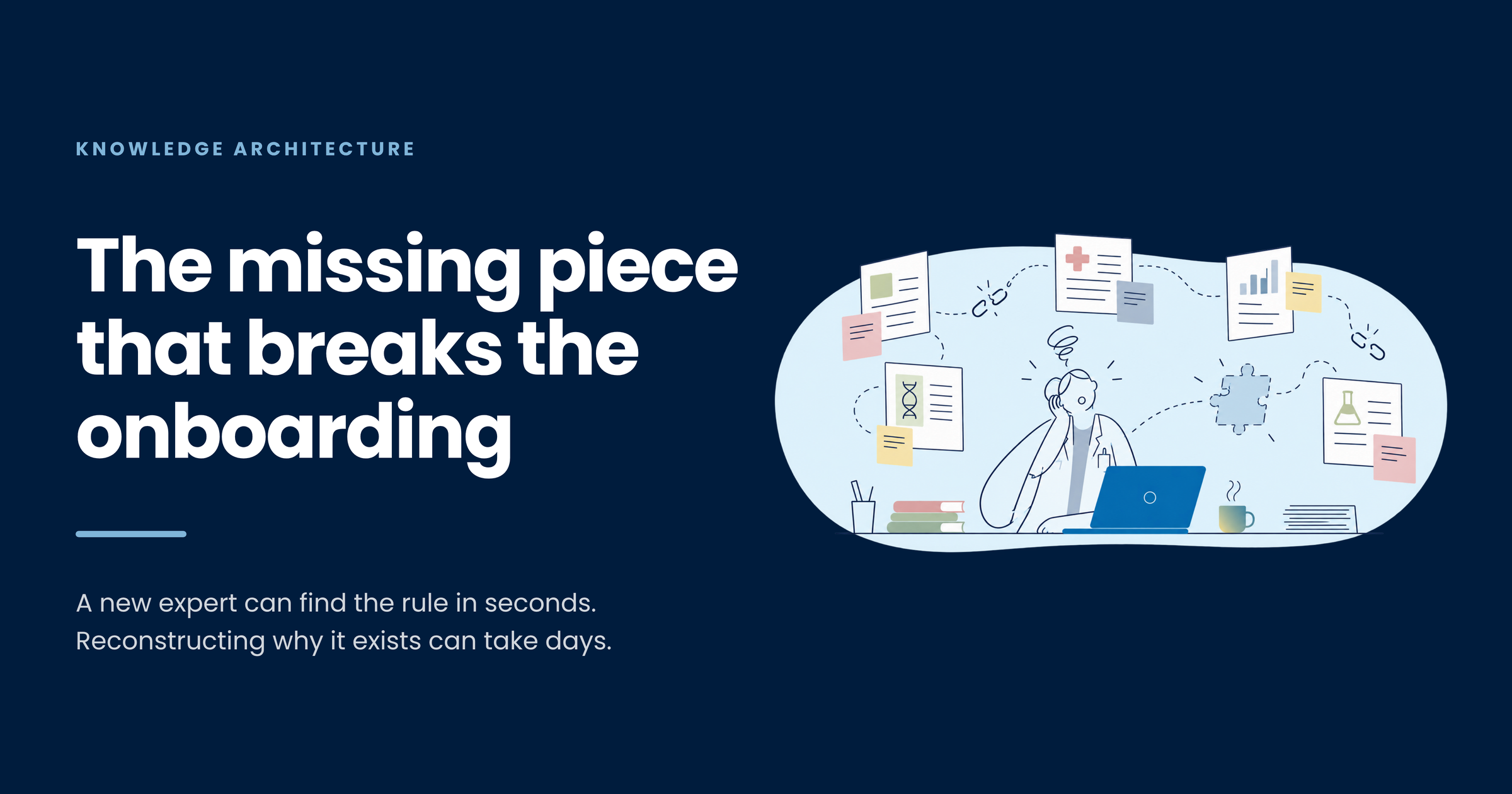
A new expert can find any rule in seconds. Reconstructing why it exists can take days. That gap is where most of the hidden cost of onboarding lives.
A new expert joins the organization.
They know the science. They understand the field. They have years, sometimes decades, of experience behind them.
Yet three months later, they are still trying to understand why the organization works the way it does.
The problem is rarely a lack of documentation.
There may be hundreds of documents.
Protocols. SOPs. Guidelines. Clinical study reports. Regulatory correspondence. Training materials. Meeting notes. Shared folders. Archived emails. Local instructions.
The problem is that the decision is documented, while the reasoning behind it is somewhere else.
And that difference has a much larger impact on onboarding than most organizations realize.
A document can tell you what. It rarely tells you the full why.
Imagine joining a clinical development team and finding an exclusion criterion in the current protocol.
The rule itself is perfectly clear. What is not clear is why it exists.
- Was it introduced after a safety signal?
- Was it requested by a regulator?
- Did it appear when a combination therapy was added?
- Does the same reasoning apply to another therapy with a similar mechanism?
The answer may exist. Just not in the protocol.
Part of it might be in an earlier amendment. Another part in a safety committee discussion. Another in regulatory correspondence from three years ago.

A new team member can find the rule in seconds. Understanding the reasoning behind it might take days.
That difference matters. Because experienced professionals are rarely hired simply to follow existing rules. They are hired to interpret situations, make decisions and apply judgment.
And judgment requires context.
The same problem appears in very different healthcare environments
Resident, night shift
There is a current, signed guideline for post-operative anticoagulation. Everyone follows it. But the resident encounters a patient who does not quite fit the standard scenario. The guideline explains what to do. It does not necessarily explain why one interpretation was chosen over another when the policy was created. So the resident asks someone more experienced.
Clinical development lead
A new lead inherits a study with several years of history. The current protocol contains a tightened exclusion criterion. Again, the rule is available. What may be much harder to reconstruct is the chain of evidence, discussion and regulatory feedback that put the line there.
Billing coordinator
A billing coordinator finds an internal coding rule created after a payer denial several years earlier. The instruction says what must be done. But nobody remembers what problem it was originally designed to prevent. Eventually someone simplifies the workflow. The same denial appears again.
Different environment. Different documents. Same underlying problem. The organization preserved the instruction. It did not preserve enough of the reasoning around it.
This is why experienced employees become human search engines
When the documentation cannot answer the next logical question, new employees do something completely rational. They ask someone who was there.
And very quickly, some of the organization’s most experienced people become its unofficial search interface.
- “Why do we do it this way?”
- “Was this a regulatory requirement?”
- “Do you remember why this changed?”
- “Which version should I be looking at?”
- “Does this apply in this situation too?”
One question is harmless. Dozens of people asking variations of the same questions every week are not.
The cost is not only the time spent by the person onboarding. It is also the interruption cost imposed on the people who already understand the organization.
The senior clinician, scientific lead, regulatory specialist or practice manager becomes the missing connection between documents.
That works surprisingly well. Until they leave.
Institutional knowledge often lives in relationships, not documents
Organizations tend to think of knowledge as information stored inside files. But much of the knowledge required for expert work exists between files.
- A finding led to a discussion.
- The discussion led to a decision.
- The decision changed a protocol.
- The protocol change affected a procedure.
- The procedure was later interpreted differently after new evidence appeared.
Each individual document may be complete. But the reasoning chain is fragmented.
That is why a folder containing every relevant document is not necessarily the same thing as an accessible knowledge base. The problem is not simply finding information. It is understanding how one piece of information relates to another.
Decision provenance
The ability to trace a current decision back through the evidence, discussions and events that shaped it.
Without that provenance, a new employee sees the current state of the organization but not the path that created it. And without the path, it is much harder to know how a rule should be interpreted when circumstances change.
Controlled documents solve one problem, not every problem
In regulated environments, there is an obvious objection. Documents are static because they need to be controlled.
Correct. Protocols, procedures, policies and regulatory records need version control, approvals and traceability. That should not disappear.
But document control and knowledge continuity are not the same thing. A version history can tell you that something changed from version 3 to version 4. A change log may even tell you which section changed. What it may not preserve is the full reasoning surrounding that change.
- Why did the issue matter?
- Which evidence influenced the decision?
- What alternatives were considered?
- What assumption was the decision based on?
- When would that assumption no longer apply?
These questions become especially important months or years later, when the people reading the document are no longer the people who created it.
The objective is therefore not to replace controlled documentation. It is to make the reasoning surrounding controlled documentation easier to retrieve and understand.
There is another problem hiding in the same system: local drift
Fragmented knowledge creates a second failure mode.
Week 2 — Master v3 · Their copy v3
Someone downloads the current version of a document during their second week. At that moment, everything is correct.
Month 3 — Master v5 · Their copy v3
Two months later, the master version changes. Their local copy does not.
Nobody deliberately decided to work from outdated information. Nobody may even notice. The employee simply continues using the document they originally received.
In an informal environment, this creates confusion and rework. In a regulated environment, the consequences can be considerably more serious.
This is sometimes treated as a version-control problem. But version control is only part of it. The deeper problem is that people are forced to build their own local working knowledge from disconnected files.
Once everyone constructs their own miniature version of the organization’s knowledge system, those versions inevitably begin to diverge.
Better onboarding is not necessarily more training
When onboarding takes too long, the instinctive response is usually to add more. More training. More introductory meetings. More reading. More checklists. More documentation.
Sometimes that helps. But if the real problem is fragmented context, adding more documents can actually make the problem worse.
The question is not
“Do new employees have enough information?”
It is
“Can they reconstruct the reasoning they need to make a decision without finding the person who remembers it?”
That is a very different test. And it explains why highly experienced hires can still struggle during onboarding. They are not struggling to understand their profession. They are trying to understand the organization’s accumulated history.
What should a usable knowledge environment make possible?
A well-structured knowledge environment does not need to eliminate documents. It needs to make their relationships visible.
Someone investigating a current rule should be able to understand where it came from, what changed it and which evidence supports it. Someone reviewing a requirement should be able to move back to the source that produced it. Someone comparing two decisions should be able to see the relevant history without manually assembling five years of context.
And when the current version changes, people should not have to discover that change accidentally.
In practical terms, useful knowledge systems should make four things easier to recover:
01
The current answer
What is the rule or decision today?
02
The source
Where did the relevant evidence or requirement originate?
03
The reasoning
Why was this particular decision made?
04
The relationship
What other decisions, documents or assumptions depend on it?
That is what turns stored information into usable institutional knowledge.
A simple test for your organization
You do not need a transformation program to determine whether this problem exists.
Try this
Take three recent changes to an important protocol, guideline, procedure or internal rule. Then ask: where is the reason for each change recorded? Not the change itself. The reason.
Then ask whether a new colleague, with no access to the people who made the original decision, could reconstruct that reasoning confidently.
If the answer requires:
…then the organization has discovered something important. The knowledge exists. But it is not really stored in a form that survives the people who created it.
The real onboarding problem may be knowledge architecture
Complex organizations will always require time to understand. Healthcare and life sciences should be complex. The decisions are consequential, the evidence changes and regulation matters.
But complexity does not automatically justify months spent reconstructing organizational history from disconnected documents.
When an experienced employee spends their first quarter searching through archives, comparing versions and repeatedly asking senior colleagues for context, the problem may not be their onboarding plan. It may be the way institutional knowledge has been structured.
Static documents are very good at preserving a moment in time. They are much less effective at preserving the relationships between decisions across time.
And those relationships are often exactly what a new expert needs in order to move from reading what the organization decided to understanding why it decided it.
That distinction is where much of the hidden cost of onboarding begins.
Where does the real answer live?
When you need the ‘why’ behind a rule, what is usually harder to recover: the document, the context, or the person who remembers it?